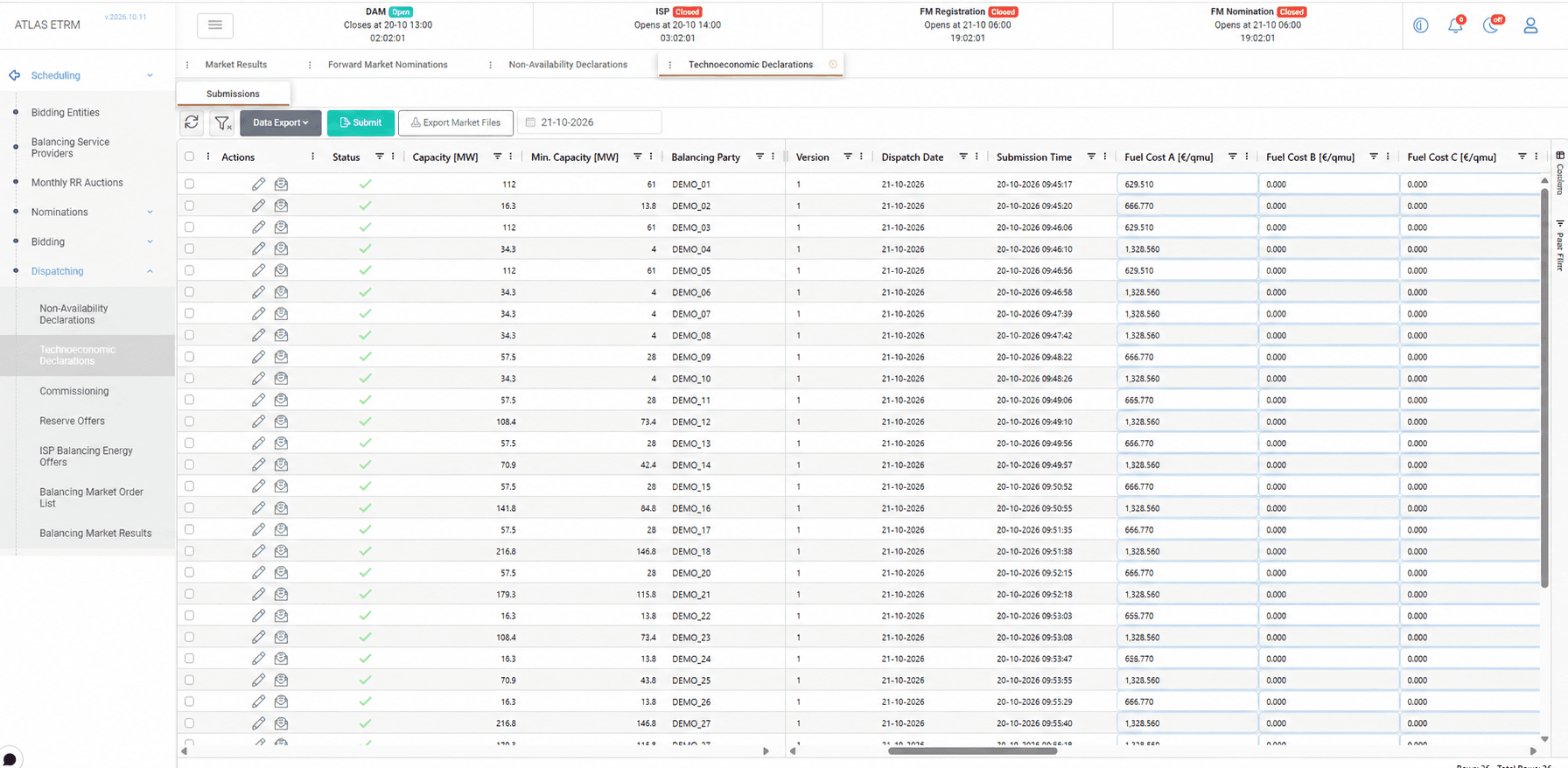
Overview
The Technoeconomic Declarations screen is used to declare the operational characteristics and the cost parameters of the generation units, which the system operator needs for the dispatch optimization of the Integrated Scheduling Process (ISP). The declarations are submitted per dispatch day, per Balancing Service Entity or portfolio, within the ISP bid submission deadline. A more recent declaration replaces any declaration that was submitted before, and if no valid declaration is submitted, the last accepted declaration remains in effect.
The declarations are based on the technoeconomic data of the assets and on the cost data of the company, so they can be prepared automatically from the latest information. The trader then only reviews and adjusts them, instead of entering them again every day.
Declarations of this type are sent directly to the market when the user submits them, without the approval step of the order lists.
For the Greek market, the screen also displays the additional parameters that the system operator requires.
Preparing and Submitting Declarations
To prepare the declarations, the user selects the day and reviews the parameters of each unit, adjusting them directly in the grid or copying them from a spreadsheet when needed. The user then submits the declaration of each unit to the market, and the status of the unit is updated automatically with the result. If a declaration is rejected, the message of the market is displayed in full, so that the parameter that needs correction can be identified easily.
The declarations can also be exported as files, so that they can be submitted through the platform of the system operator if the interface is not available. Every submission is recorded in the Balancing Market Order List, where its history and status can be reviewed.
The Submissions tab displays the declarations that have already been submitted for the selected day, and each declaration can be reopened for editing or sent to the market from the actions of its row.
For battery energy storage systems (BESS), the declaration also draws on the technoeconomic properties of the asset in the portfolio management, which describe how the battery supports the grid, such as its frequency response, its voltage support and its fault response. This ensures that the characteristics declared to the market are consistent with the data of the asset.
For thermal units, the platform helps the trader to avoid unfeasible orders by checking the hybrid and block orders against the technical characteristics of the unit and its state on the previous day. The check covers the start-up sequence, the minimum up and down times, the technical minimum and the offering of the full available capacity, and it warns the trader when an offer could lead to a schedule that the unit cannot follow. Each finding indicates the period concerned, so that the order can be corrected quickly. The findings are advisory and do not prevent the submission of the orders.
Appendix - Field Details
Field / Element | Description |
|---|---|
Date selector | Selects the dispatch day. |
Submissions | Displays the declarations for the selected day. |
Actions | Provides row actions for editing and submitting a declaration. |
Status | Indicates the result of the latest submission. |
Capacity [MW] | Capacity of the unit. |
Min. Capacity [MW] | Minimum operating capacity of the unit. |
Balancing Party | Unit or provider to which the declaration refers. |
Version | Version number of the declaration. |
Dispatch Date | Day to which the declaration applies. |
Submission Time | Date and time of submission. |
Fuel Cost A [€/qmu] | Fuel cost parameter A of the declaration. |
Fuel Cost B [€/qmu] | Fuel cost parameter B of the declaration. |
Fuel Cost C [€/qmu] | Fuel cost parameter C of the declaration. |
Submit | Submits declarations to the market. |
Export Market Files | Exports declarations in the market file format. |
Data Export | Exports grid data. |